
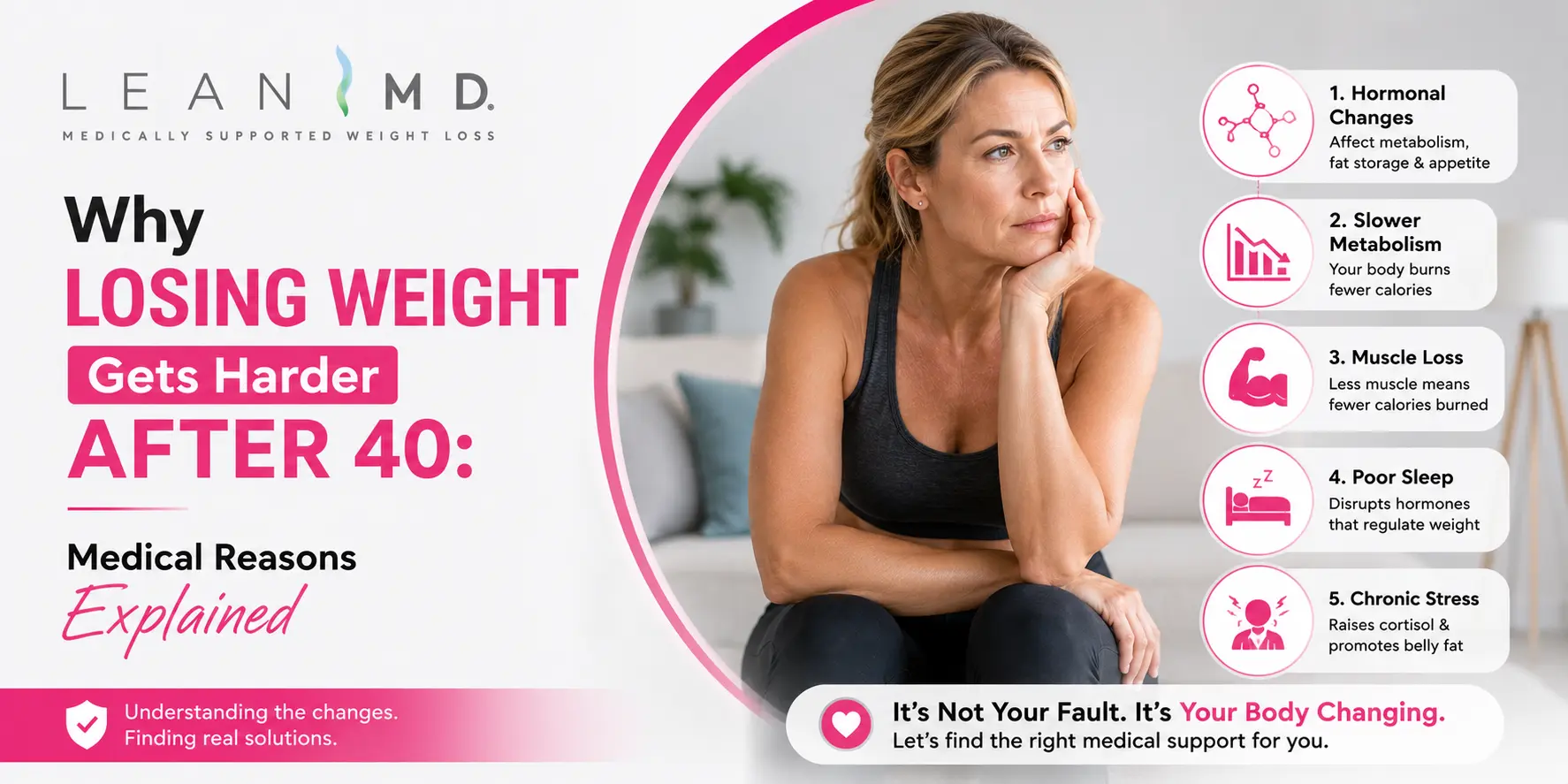
You’re doing what worked at 30. The same healthy eating habits, the same exercise routine, maybe even more discipline than before. But the results are not the same and the weight that used to come off in a few weeks now barely budges in months.
This is one of the most common and most demoralizing experiences people have with weight management after 40. And the worst part is that most of the advice they receive eat less, move more, try harder completely misses the actual reason it is harder.
The difficulty is not personal. It is physiological. After 40, a series of measurable, documented biological changes make weight loss genuinely more difficult. This is not an excuse it is a medical reality. And like all medical realities, understanding it is the first step toward working with it rather than fighting against it.
Here are the seven primary medical reasons weight loss gets harder after 40, and what the evidence says actually helps.
| THE REAL REASON Weight loss gets harder after 40 because of real, measurable biological changes not a lack of willpower. Hormones shift, muscle mass declines, insulin sensitivity drops, and metabolism adapts in ways that make the strategies that worked at 30 increasingly ineffective by 45. Understanding these changes — and adapting your approach accordingly — is what makes the difference. |
| 3–8% Muscle mass lost per decade after 30 without resistance training | 1–2% Annual testosterone decline in men after age 30 | 500+ Fewer calories burned per day by age 50 compared to age 25, due to muscle loss |
1. Muscle Mass Declines — And That Slows Everything
Of all the biological changes that happen after 40, muscle loss technically called sarcopenia has the most direct and significant impact on weight management. Most people know they lose muscle with age; very few understand how profoundly this affects their ability to lose fat.
The metabolism connection
Muscle is the most metabolically active tissue in the body. Each kilogram of muscle burns approximately 13 calories per day at rest just existing. When you lose muscle, your resting metabolic rate falls accordingly. Studies estimate that by age 50, the average person burns 200–500 fewer calories per day than they did at age 25 almost entirely due to muscle loss.
This means the same diet and activity level that kept you at a healthy weight at 28 will cause weight gain at 48. Not because you changed because your body’s calorie-burning capacity did.
Why conventional dieting makes it worse
The most common response to weight gain cutting calories significantly accelerates muscle loss. When you eat below your protein needs in a calorie deficit, your body breaks down muscle tissue for energy. You lose weight, but the proportion coming from muscle can be alarmingly high. This further slows your metabolism, making the next diet attempt even harder than the last.
What actually helps
- Resistance training 2–3 times per week — the single most effective intervention to preserve and rebuild muscle after 40
- Protein intake of 1.2–1.6g per kg body weight daily — the threshold at which muscle protein synthesis is adequately stimulated
- Distribute protein across meals — 25–40g per meal maximizes the muscle-building signal
- Moderate calorie deficit only — no more than 500 calories below maintenance to preserve lean mass
| LeanMD’s Muscle-First Protocol: This is the central design principle of LeanMD’s program. Every patient receives personalized protein guidance, resistance exercise recommendations, and ongoing monitoring of lean mass — not just scale weight. The goal is always fat loss, not just weight loss. |
2. The Complete Hormone Picture After 40
Hormones regulate metabolism, appetite, fat storage, energy, and mood. After 40, virtually every major metabolic hormone changes in directions that make weight management harder. Here is the full picture:
| Hormone | Change After 40 | Effect on Weight & Body Comp | What You Can Do |
| Estrogen (women) | Declines in perimenopause | Fat shifts to abdomen; insulin resistance worsens | Protein-first diet, strength training, physician eval |
| Testosterone (men & women) | Drops 1–2%/year after 30 | Muscle loss accelerates; fat storage increases | Resistance training, sleep, physician testosterone eval |
| Growth Hormone | Significant decline | Less fat burning; reduced muscle repair | Heavy compound lifts, quality sleep, protein timing |
| Cortisol | Often chronically elevated | Promotes belly fat; breaks down muscle | Stress management, sleep hygiene, avoid crash diets |
| Insulin | Sensitivity declines | More fat stored from same food intake | Reduce refined carbs, increase protein, exercise |
| Leptin | Resistance develops | Brain ignores fullness — appetite dysregulated | Avoid ultra-processed foods, prioritize sleep |
| Thyroid (T3/T4) | Can slow with age | Lower metabolic rate; weight gain despite diet | Annual thyroid panel recommended after 40 |
| The Compounding Effect: These hormonal changes do not happen in isolation — they compound each other. Declining estrogen worsens insulin sensitivity. Low testosterone accelerates muscle loss. Elevated cortisol from chronic stress suppresses thyroid function. This interconnected hormonal environment is why a simple calorie deficit that worked at 30 is physiologically insufficient at 45. Addressing one factor while ignoring others consistently underdelivers. |
3. Insulin Resistance: The Hidden Weight Loss Blocker
Insulin resistance is one of the most common — and most commonly missed — reasons weight loss becomes increasingly difficult after 40. It affects an estimated 40% of adults in the United States, and the majority are undiagnosed.
What insulin resistance means for weight
Insulin is the hormone that helps your cells absorb glucose from the bloodstream. When cells become resistant to insulin’s signal, the pancreas compensates by producing more. Chronically elevated insulin is one of the most potent fat-storage signals in the body — it actively inhibits fat breakdown and promotes fat accumulation, particularly in the abdomen.
This means two people eating exactly the same meal can have completely different weight outcomes if one has insulin resistance. The person with insulin resistance stores more of that meal as fat — not because of different calories, but because of different hormonal responses to the same food.
How to identify it
- Fasting blood glucose above 100 mg/dL (pre-diabetic range)
- Fasting insulin above 10 uIU/mL — a more sensitive marker than glucose alone
- HbA1c between 5.7% and 6.4% — indicates 3-month average blood sugar elevation
- Abdominal fat that resists dieting, strong sugar cravings, energy crashes after meals
- Skin tags or darkened skin patches around neck and armpits (acanthosis nigricans)
What helps
- Reducing refined carbohydrates and ultra-processed foods — the primary drivers of insulin spikes
- Protein-forward eating — protein has minimal insulin impact compared to carbohydrates
- Resistance training — muscle tissue acts as a glucose sink, dramatically improving insulin sensitivity
- Adequate sleep — even one week of sleep restriction significantly worsens insulin sensitivity
- GLP-1 medications like semaglutide and tirzepatide — directly improve insulin sensitivity and reduce the hyperinsulinemia that blocks fat loss
Read More :- GLP-1 Weight Loss Medications: Benefits, Side Effects, and Who Qualifies
4. Cortisol and Chronic Stress: The Belly Fat Hormone
Cortisol is your body’s primary stress hormone. In short bursts, it is protective and useful. When it is chronically elevated — due to work stress, poor sleep, relationship pressure, financial worry, or even the stress of repeated failed diets — it becomes one of the most significant drivers of weight gain after 40.
What chronic cortisol does to body composition
- Directs fat storage specifically to the visceral abdomen — the most metabolically stubborn and health-damaging fat depot
- Breaks down muscle tissue for energy, accelerating the sarcopenia process
- Raises blood sugar and increases insulin, compounding insulin resistance
- Increases cravings for high-calorie, high-fat, high-sugar comfort foods through its effects on dopamine pathways
- Suppresses thyroid hormone conversion, reducing metabolic rate
The dieting paradox
Here is the cruel irony: extreme calorie restriction is itself a physiological stressor that raises cortisol. This is one of the primary mechanisms by which crash diets backfire — the more extreme the restriction, the higher the cortisol, and the more the body works to store fat rather than burn it. This is not weakness. It is physiology.
| Stress Management Is a Weight Loss Strategy: After 40, chronic stress management is not a soft lifestyle tip — it is a direct intervention in the hormonal environment that determines your ability to lose fat. Sleep, structured relaxation, workload boundaries, and moderate (not extreme) dietary approaches all reduce cortisol and improve body composition outcomes. |
5. Thyroid Function: The Metabolism Regulator
The thyroid gland produces hormones (T3 and T4) that regulate metabolic rate across every cell in the body. Thyroid dysfunction — particularly hypothyroidism (underactive thyroid) — is significantly more common in people over 40, especially women.
Even subclinical hypothyroidism — where TSH is mildly elevated but T4 is still technically normal — can reduce metabolic rate by 10–15% and cause meaningful difficulty with weight management. It is estimated that up to 60% of people with thyroid dysfunction are undiagnosed.
Symptoms that suggest thyroid involvement
- Weight gain or inability to lose weight despite consistent effort
- Persistent fatigue even with adequate sleep
- Feeling cold when others are comfortable
- Hair thinning, brittle nails, dry skin
- Depression, brain fog, poor concentration
- Constipation and slowed digestion
Why it matters after 40 specifically
Thyroid function naturally tends to decline with age, and the symptoms of hypothyroidism overlap significantly with normal aging — fatigue, weight gain, reduced energy. This overlap means thyroid issues are frequently missed or attributed to lifestyle when there is an underlying medical cause. An annual thyroid panel (TSH, free T3, free T4) after 40 is a straightforward screen that catches this reliably.
6. Sleep Disruption: The Underestimated Weight Loss Barrier
Sleep is not a passive recovery state — it is an active metabolic and hormonal process. Poor sleep quality or insufficient duration directly impairs almost every biological system involved in weight management.
What happens to your body with poor sleep
- Ghrelin (hunger hormone) increases by up to 28% after one night of poor sleep
- Leptin (fullness hormone) decreases by up to 18%, meaning hunger signals are amplified and fullness signals suppressed simultaneously
- Cortisol rises significantly with sleep deprivation
- Insulin sensitivity drops measurably after even 3–4 nights of restricted sleep
- Growth hormone secretion — which primarily occurs during deep sleep — is suppressed
- Decision-making and impulse control are impaired — food choices worsen predictably
Why this is worse after 40
Sleep quality naturally declines with age — more time in lighter sleep stages, more frequent waking, less deep slow-wave sleep. Women in perimenopause and menopause face additional sleep disruption from night sweats and hormonal fluctuations. Men experience reduced growth hormone secretion during sleep as testosterone falls. The cumulative effect is that after 40, the sleep-weight connection becomes more pronounced even as sleep quality becomes harder to maintain.
| The Non-Negotiable: Seven to nine hours of quality sleep per night is not a lifestyle preference after 40 — it is a metabolic intervention. Patients who consistently sleep fewer than 6 hours are working against their own weight loss biology regardless of how good their diet and exercise are. |
Read More :- High Protein Diet for Weight Loss: A Complete Beginner’s Guide
7. The Accumulation Effect: Why It All Compounds
The seven factors above do not operate independently — they compound each other in ways that explain why the difficulty of weight loss after 40 is so much greater than the sum of individual parts.
Declining estrogen worsens insulin resistance. Insulin resistance raises cortisol. Elevated cortisol disrupts sleep. Poor sleep raises ghrelin and cortisol further. High cortisol breaks down muscle. Less muscle slows metabolism. A slower metabolism makes the same diet insufficient. A frustrated patient cuts calories more aggressively. More restriction raises cortisol more. The cycle compounds.
This is not a personal failing. This is a biological cascade that generic dieting advice was never designed to address. It requires a physician who can evaluate the whole picture — labs, hormones, metabolic markers, medication history — and build a strategy that works with the biology rather than against it.
8. What Actually Works After 40: The Evidence-Based Approach
| ✓ What WORKS After 40 | ✗ What DOESN’T Work After 40 |
| Protein-forward eating (1.2–1.6g/kg/day) | Extreme calorie restriction below 1,000–1,200 cal |
| Progressive resistance training 2–3x/week | High-volume cardio without strength training |
| Moderate calorie deficit (300–500 cal/day max) | Low-fat, high-carb diets (worsens insulin sensitivity) |
| 7–9 hours quality sleep — non-negotiable | Generic meal replacement programs |
| Stress management: cortisol is a fat storage signal | Ignoring hormonal and metabolic lab markers |
| Physician-supervised metabolic assessment | Applying the same approach that worked at 30 |
| GLP-1 medication when clinically appropriate | Stopping and starting repeatedly (worsens adaptation) |
| Annual labs: thyroid, insulin, testosterone, HbA1c | Relying on willpower alone against biological changes |
The pattern across everything that works after 40 is consistent: address biology first, demand of willpower second. Physician-supervised metabolic assessment, lab-based identification of specific barriers, and a treatment plan that accounts for hormonal reality produces results that calorie restriction alone cannot match.
| Weight Loss After 40 Requires a Different Approach — LeanMD Provides It. Physician-supervised metabolic assessment, personalized protein guidance, GLP-1 medication when appropriate, and a muscle-first protocol designed for the biological realities of weight loss after 40. Visit leanmd.com | Call (888) 264-2003 | Find a LeanMD Physician Near You |
Frequently Asked Questions
Why is it so much harder to lose weight after 40 than it was at 30?
After 40, multiple biological systems change simultaneously: muscle mass declines (reducing metabolic rate), key hormones shift (estrogen, testosterone, growth hormone, insulin sensitivity), sleep quality deteriorates, and the hormonal response to calorie restriction becomes more problematic. These changes compound each other, creating a metabolic environment that is genuinely more resistant to the approaches that worked at a younger age.
Is it still possible to lose weight after 40?
Absolutely — but it requires a strategy matched to the biological reality of the post-40 body. The people who successfully lose and maintain weight after 40 are those who shift from calorie-only approaches to strategies that address hormonal health, muscle preservation, sleep, and stress alongside nutrition. Physician-supervised programs that account for these factors consistently outperform self-directed dieting in this age group.
Does metabolism really slow down after 40?
Yes, but the mechanism matters. Metabolic rate does not slow primarily because of a mysterious aging process — it slows because muscle mass declines, and muscle is the primary driver of resting calorie burn. Research estimates the average person burns 200–500 fewer calories per day at 50 than at 25, almost entirely due to accumulated muscle loss. The practical implication: preserving and rebuilding muscle through resistance training and adequate protein is the most effective metabolic intervention available.
What blood tests should I ask for if I’m struggling to lose weight after 40?
A comprehensive metabolic weight loss evaluation after 40 should include: TSH (thyroid), free T3 and T4, fasting insulin, fasting glucose, HbA1c, comprehensive metabolic panel, lipid panel, and testosterone (both men and women). In women approaching or past menopause, estrogen and FSH levels are also relevant. These tests identify the specific biological barriers most likely to be working against your efforts — and cannot be determined from symptoms alone.
Can GLP-1 medications help with weight loss after 40?
Yes — GLP-1 medications like semaglutide (Wegovy) and tirzepatide (Zepbound) are clinically effective for adults with obesity regardless of age. However, the muscle loss concern associated with these medications is particularly significant after 40, where age-related sarcopenia is already underway. This makes personalized protein guidance and resistance exercise non-negotiable components of any GLP-1 program for patients over 40 — exactly the framework LeanMD provides.
What is the best diet for losing weight after 40?
The evidence most consistently supports a protein-forward, moderate-carbohydrate approach after 40 — sometimes called a modified Mediterranean or low-glycemic diet. Key principles: minimum 1.2g protein per kg body weight daily (higher is better for muscle preservation), reduced refined carbohydrates and sugar to improve insulin sensitivity, adequate healthy fats to support hormone production, and total calories at a moderate deficit (300–500 below maintenance maximum). Extreme restriction consistently backfires after 40 by raising cortisol and accelerating muscle loss.
Medical Disclaimer
This article is for informational purposes only and does not constitute medical advice. Always consult a qualified healthcare provider before making changes to your diet, exercise routine, or medication. LeanMD’s program is physician-supervised and personalized to each individual patient.
Read More :- Sustainable Weight Loss After 40: Why Hormones and Muscle Mass Matter More Than Calories