
You are doing the same things that worked in your 30s — eating less, moving more, cutting carbs. But the scale refuses to cooperate. Sound familiar?
If you are over 40 and struggling to lose weight, you are not imagining it. Something genuinely is different. And the reason most conventional weight loss advice fails people after 40 is that it was designed for a younger body.
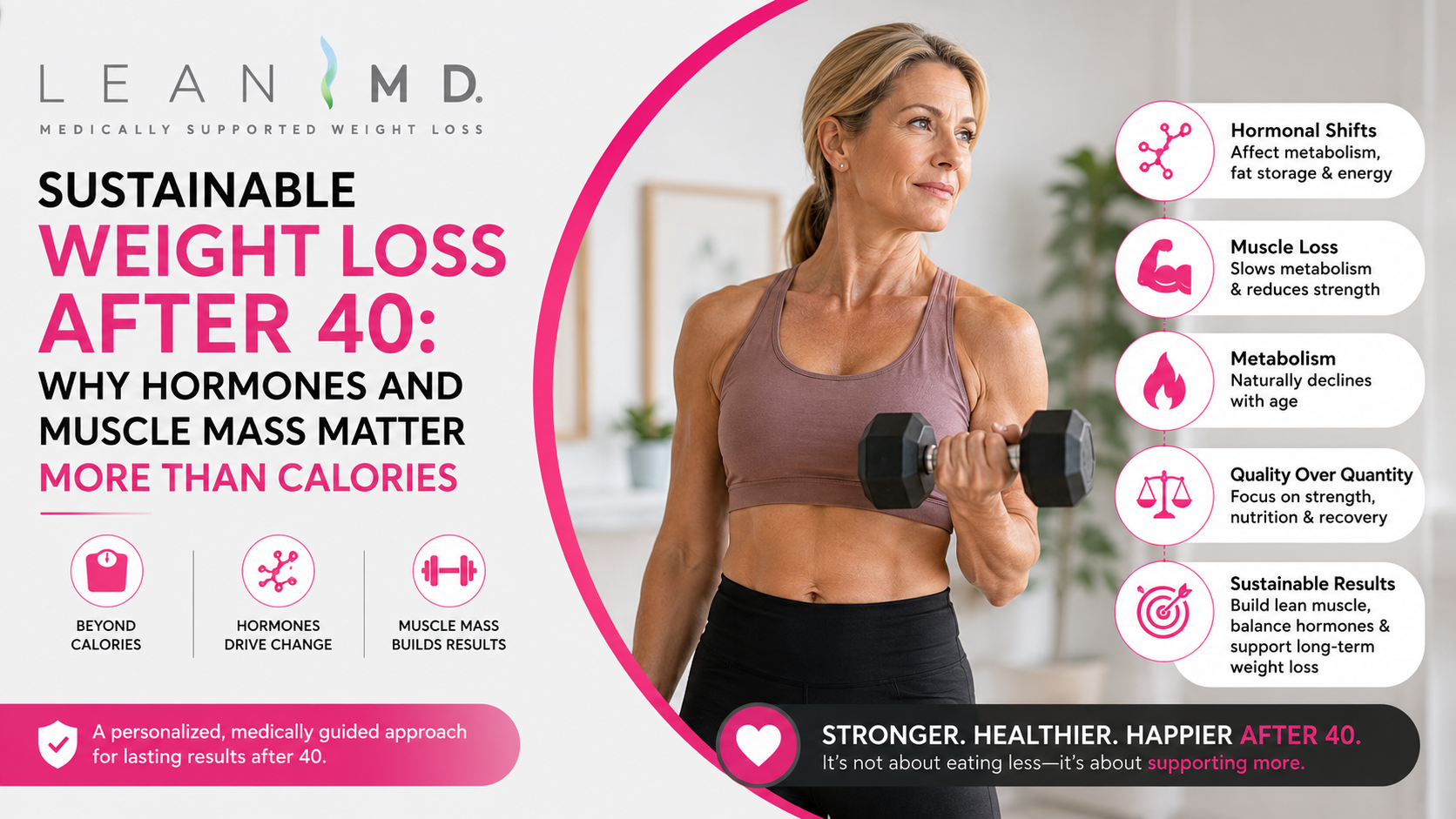
After 40, the rules change. Hormones shift. Muscle mass declines. Metabolism slows in ways that have nothing to do with willpower or effort. The strategies that worked at 30 — restrict calories, do more cardio, eat less fat — can actually backfire after 40, leaving you frustrated, fatigued, and stuck.
This guide explains exactly what changes after 40, why those changes make weight loss harder, and what the science says actually works — including why protecting your muscle mass and understanding your hormonal environment matters far more than the number of calories on your plate.
| THE BOTTOM LINE After 40, weight loss requires a fundamentally different approach. Declining hormones — estrogen, testosterone, and growth hormone — shift fat storage, slow metabolism, and accelerate muscle loss. Counting calories alone does not address these changes. What does: protecting and building muscle, optimizing protein intake, managing hormonal health, and working with a physician who understands the biology of aging metabolism. |
| 3–8% Muscle mass lost per decade after age 30 without resistance training | 40% Of weight lost on GLP-1 medications can be muscle — without proper support | 1–2% Annual decline in testosterone in men after age 30 |
1. Why Weight Loss Gets Harder After 40: The Biology
The frustration of weight loss after 40 is not in your head. It is rooted in real, measurable physiological changes that begin in your mid-30s and accelerate through your 40s and 50s. Understanding these changes is the first step toward working with your body — not against it.
Your metabolic rate slows — but not the way you think
Most people assume their metabolism slows with age because their thyroid is underperforming or because of some mysterious aging process. The truth is more specific and more actionable: metabolism slows primarily because you lose muscle mass as you age.
Muscle is metabolically active tissue. Each kilogram of muscle burns approximately 13 calories per day at rest. When you lose muscle — which happens at a rate of 3–8% per decade after age 30 without resistance training — your resting metabolic rate drops accordingly. This means you need fewer calories to maintain the same weight, which makes the same diet that maintained your weight at 32 now cause weight gain at 42.
Fat storage patterns change
Before menopause, estrogen directs fat storage toward the hips and thighs. After menopause — and during perimenopause, which can begin in the early 40s — declining estrogen causes the body to redirect fat storage toward the abdomen. This visceral abdominal fat is more metabolically active and more strongly linked to insulin resistance, cardiovascular disease, and inflammation than subcutaneous fat.
For men, declining testosterone produces a similar shift — less muscle, more abdominal fat — and the process begins even earlier, with testosterone dropping approximately 1–2% per year after age 30.
Insulin sensitivity declines
After 40, most people experience a meaningful decline in insulin sensitivity. This means the same carbohydrate-heavy meal that your body handled efficiently at 28 now results in higher blood sugar, more insulin release, and more fat storage — even if the calorie count is identical.
This is why the low-fat, moderate-carbohydrate diet advice that dominated the 1990s produces such disappointing results for people over 40. The dietary approach needs to change as the metabolic environment changes.
2. The Hormone Map: What Changes and What It Means
Here is a comprehensive look at every major hormonal shift that affects weight after 40, what happens, and what it means in practice:
| Hormone | Change After 40 | Effect on Weight | What It Means for You |
| Estrogen (women) | Declines during perimenopause | Fat shifts to abdomen; insulin resistance rises | Belly fat harder to lose; carbs processed less efficiently |
| Testosterone (men & women) | Drops 1–2% per year | Muscle loss accelerates; fat storage increases | Slower metabolism; harder to build/keep muscle |
| Growth Hormone | Declines significantly | Less fat burning; more fat storage | Reduced body composition even with same diet |
| Cortisol | Often elevated chronically | Promotes belly fat storage; breaks down muscle | Stress management becomes a weight loss strategy |
| Insulin | Sensitivity decreases | More fat stored from same food intake | Protein-forward eating becomes critical |
| Leptin | Resistance increases | Brain ignores fullness signals | Appetite feels out of control despite adequate eating |
| Key Insight: These hormonal shifts do not mean weight loss is impossible after 40 — they mean it requires a different strategy. The approach that ignores these changes and focuses only on calorie counting will consistently underperform for people in this life stage. |
Read More :- High Protein Diet for Weight Loss: A Complete Beginner’s Guide
3. Muscle Mass: The Most Overlooked Factor in Weight Loss After 40
Of all the factors that determine whether weight loss is successful and sustainable after 40, muscle mass is the most important — and the most consistently ignored by conventional weight loss programs.
Why muscle mass matters more after 40
Muscle serves as your metabolic engine. It determines how many calories you burn at rest, how effectively your body uses glucose, and how resilient your metabolism is after weight loss. When muscle mass is high, your body handles food more efficiently. When muscle mass is low, even a modest calorie surplus leads to fat gain.
The cruel irony is that the most common weight loss strategies — significant calorie restriction and extensive cardio — are the approaches most likely to cause muscle loss. When you create a large calorie deficit without adequate protein and resistance exercise, your body breaks down muscle tissue for energy. You lose weight, but you lose the wrong kind.
The GLP-1 and muscle loss problem
This issue has become especially relevant with the widespread adoption of GLP-1 medications like semaglutide and tirzepatide. These medications produce rapid, significant weight loss — but studies from the STEP and SURMOUNT clinical trials show that without proper nutritional support, up to 40% of the weight lost on GLP-1 medications can come from lean muscle mass rather than fat.
This creates a compounding problem: you lose significant muscle during the weight loss phase, which lowers your resting metabolic rate, which makes it far harder to maintain weight after the medication ends or is tapered. Many patients who experience dramatic regain after stopping GLP-1 medications are experiencing this exact mechanism.
| LeanMD’s Muscle-First Approach: This is the central problem that LeanMD was designed to solve. Through 1:1 coaching, personalized protein guidance targeting 1.2–1.6g per kg of body weight, strength-focused movement plans, and muscle mass monitoring throughout treatment, LeanMD ensures patients lose fat — not the muscle they need to maintain their results. |
How to protect muscle mass while losing weight after 40
The evidence on muscle preservation during weight loss is clear. The following approaches are consistently supported by research:
- Prioritize protein at every meal — target a minimum of 1.2g of protein per kilogram of body weight daily; after 40, some evidence supports going as high as 1.6g/kg
- Distribute protein evenly — consuming 25–40g of protein per meal maximizes muscle protein synthesis; front-loading protein at breakfast is especially beneficial
- Resistance training at least 2–3 times per week — progressive overload (gradually increasing weight or resistance) signals the body to preserve and build muscle even in a calorie deficit
- Avoid extreme calorie restriction — deficits larger than 500–750 calories per day significantly increase the proportion of weight lost from muscle rather than fat
- Ensure adequate leucine intake — leucine is the amino acid most responsible for triggering muscle protein synthesis; found abundantly in chicken, eggs, dairy, and whey protein
Read More :- How Long Do You Stay on Semaglutidefor Weight Loss?
4. Weight Loss After Menopause: What Women Over 40 Need to Know
Menopause — and the perimenopause period that precedes it, often beginning in the early to mid-40s — represents the most significant hormonal shift in a woman’s life. Its effects on body composition and weight are profound and underappreciated.
The estrogen-belly fat connection
Estrogen receptors are present in fat tissue. When estrogen declines, fat distribution changes — away from the hips and thighs and toward the abdomen. This is not cosmetic: visceral abdominal fat is biologically distinct from subcutaneous fat. It produces inflammatory signals, worsens insulin resistance, and is more strongly linked to cardiovascular risk. It is also, frustratingly, more resistant to conventional dieting.
Sleep disruption compounds everything
Perimenopause and menopause are often accompanied by significant sleep disruption — night sweats, insomnia, and fragmented sleep. Poor sleep independently raises cortisol, increases hunger hormones (ghrelin), suppresses fullness hormones (leptin), and reduces insulin sensitivity. A woman in perimenopause managing all of these hormonal shifts simultaneously faces a genuinely challenging metabolic environment that is not addressed by simply eating less.
What actually works for women over 40
- Strength training is non-negotiable — muscle loss accelerates after menopause; resistance exercise is the most effective intervention to prevent it
- Protein intake becomes even more important — estrogen has a protective effect on muscle protein synthesis; after menopause, higher protein intake compensates
- Managing cortisol matters — sleep, stress reduction, and avoiding very low calorie diets all reduce the cortisol burden that drives abdominal fat storage
- Physician-supervised programs that account for hormonal context outperform generic calorie-restriction approaches for this demographic
| LeanMD Patient Story: Rochelle had her third child at 40 and struggled to lose the last few stubborn pounds. Nilda was motivated by high blood pressure and a family history of diabetes — she lost over 40 pounds and dropped 3 dress sizes. Both represent the woman over 40 whose biology demanded a more sophisticated approach than generic dieting. |
5. Weight Loss After 40 for Men: The Testosterone Factor
Men over 40 face their own hormonal landscape — one that is changing more rapidly than most realize. Testosterone, the primary anabolic hormone in men, declines at approximately 1–2% per year after age 30. By the time a man reaches his mid-40s, testosterone levels may be 15–25% lower than they were at their peak.
How low testosterone affects body composition
Testosterone plays a direct role in maintaining muscle mass and regulating fat storage. As testosterone declines, the body preferentially stores more fat — particularly visceral abdominal fat — while simultaneously becoming less efficient at building or maintaining muscle. This is sometimes called andropause or late-onset hypogonadism, and it creates a body composition trajectory that calorie restriction alone cannot reverse.
Men with clinically low testosterone who attempt conventional calorie-restricted diets often find they lose weight initially but regain it quickly — and the weight they regain is disproportionately fat rather than the muscle they lost. This is the low-testosterone weight cycling trap.
What helps men over 40
- Heavy compound resistance training — squats, deadlifts, rows, and presses produce the strongest testosterone and growth hormone responses
- Adequate sleep — testosterone is primarily produced during deep sleep; even one week of sleep restriction significantly lowers testosterone levels
- Protein intake of 1.4–1.6g/kg body weight — supports muscle preservation in the lower-testosterone environment
- Physician evaluation of testosterone levels — if clinically low, addressing this directly changes the weight loss trajectory significantly
- Avoiding chronic extreme calorie restriction — very low calorie diets further suppress testosterone production
6. What Actually Works for Sustainable Weight Loss After 40
Given everything we know about the hormonal and metabolic shifts after 40, here is what the evidence consistently supports as effective strategies — and what the evidence says to leave behind.
What works
- Protein-forward eating — minimum 1.2–1.6g protein per kg body weight daily, distributed across 3–4 meals
- Progressive resistance training — 2–3 sessions per week, with gradual increases in weight or resistance over time
- Sleep optimization — 7–9 hours of quality sleep is a metabolic intervention, not a luxury
- Stress management — chronic cortisol elevation is a direct cause of abdominal fat storage and weight loss resistance
- Physician-supervised medical approach — addresses hormonal context, metabolic health markers, and can incorporate evidence-based medication when appropriate
- Sustainable calorie deficit — 300–500 calories below maintenance rather than extreme restriction, to preserve muscle and avoid cortisol spikes
- Adequate dietary fat — low-fat diets suppress hormone production; healthy fats from avocado, olive oil, nuts, and fatty fish support hormonal health
What does not work after 40
- Extreme low-calorie diets (below 1,000–1,200 calories) — accelerate muscle loss and raise cortisol, producing short-term loss followed by rebound
- High-volume steady-state cardio without resistance training — burns calories but does not preserve muscle and can increase cortisol
- Low-fat, high-carbohydrate diets — incompatible with declining insulin sensitivity after 40
- Generic meal replacement programs — ignore the hormonal context and typically cause muscle loss alongside fat loss
- Weight loss without medical supervision — misses the hormonal, metabolic, and medication factors that are often driving weight loss resistance
| The Calorie Myth After 40: Calories matter — but they are not the whole story after 40. Two people eating the same number of calories with different hormonal profiles, different muscle mass levels, and different sleep and stress situations will have dramatically different weight outcomes. A physician-supervised approach addresses the full picture, not just the number on the nutrition label. |
7. The LeanMD Approach to Weight Loss After 40
LeanMD was built specifically to address the medical realities of weight loss — including the hormonal and metabolic complexities that become dominant after 40. Here is how the program is structured to work with your body, not against it.
Phase 1: Weight Loss (2–12 months)
Physician-supervised fat loss with 1:1 medical coaching, personalized protein guidance, and access to evidence-based weight loss medication including GLP-1 and GLP-1/GIP agonists (semaglutide, tirzepatide) and Lipotropic B12 injections. Critically, muscle mass monitoring is integrated from day one — ensuring the weight you lose is fat, not the lean tissue you need.
Phase 2: Transition (3–5 weeks)
A carefully managed transition phase that bridges active weight loss to sustainable maintenance. This is when eating habits are consolidated, medication is tapered under physician supervision, and the body adjusts to its new metabolic setpoint — with support at every step.
Phase 3: Sustainable Weight Loss (12 months)
Long-term maintenance with continued physician support. After 40, this phase is where most programs fail their patients — LeanMD’s 12-month Phase 3 ensures the weight you lost stays lost, with ongoing coaching, habit reinforcement, and medical oversight.
| Not One Size Fits All: LeanMD tailors every program to the individual needs of each patient — nutrition, supplements, and weight-loss medication — because two people over 40 may look similar on paper but have completely different hormonal environments, metabolic health markers, and weight loss barriers. Personalization is not a feature of LeanMD. It is the foundation. |
| Losing Weight After 40? LeanMD Was Built for This. Our physician-supervised program addresses the hormonal and metabolic realities of weight loss after 40 — with 1:1 coaching, personalized protein plans, muscle mass monitoring, and the medical oversight that makes results sustainable. Visit leanmd.com | Call (888) 264-2003 | Find a LeanMD Physician Near You |
Frequently Asked Questions
Is it really harder to lose weight after 40, or is it a myth?
It is real and well-documented. After 40, muscle mass declines, hormones shift, insulin sensitivity decreases, and fat storage patterns change — particularly toward the abdomen. These are measurable physiological changes, not excuses. However, harder does not mean impossible. It means you need a different strategy than the one that worked when you were younger.
What is the best diet for weight loss after 40?
The evidence most consistently supports a protein-forward diet with adequate healthy fats and moderate carbohydrates — sometimes called a Mediterranean or modified low-glycemic approach. The key principles: minimum 1.2g protein per kg body weight daily, reduced refined carbohydrates and sugar, healthy fats from whole food sources, and total calories at a modest deficit (300–500 below maintenance). Extreme restriction consistently backfires after 40.
Can exercise alone reverse weight gain after 40?
Resistance training is essential and non-negotiable for anyone over 40 trying to lose weight sustainably. However, exercise alone — particularly without dietary protein adequacy — is rarely sufficient for significant fat loss. The research consistently shows that the combination of resistance training, adequate protein, and physician-supervised nutrition produces far better body composition outcomes than any single intervention alone.
Does menopause cause permanent weight gain?
Menopause causes real changes in body composition and fat distribution, but it does not make weight management impossible. What it does require is adapting your approach: more emphasis on resistance training, higher protein intake, sleep and stress management, and often medical support to address the specific hormonal context. Women who make these adaptations can and do achieve significant, sustainable weight loss after menopause.
Can semaglutide or GLP-1 medications help with weight loss after 40?
Yes — GLP-1 medications like semaglutide (Wegovy) and tirzepatide (Zepbound) are effective for adults with obesity regardless of age. However, the muscle loss risk associated with these medications is especially significant for people over 40, who already have an age-related tendency toward muscle loss. This makes physician supervision, personalized protein guidance, and resistance training non-negotiable when using GLP-1 medications after 40 — exactly the framework LeanMD provides.
How long does it take to lose weight after 40?
Expect a longer timeline than you may have experienced when younger — and frame this as a positive, not a negative. Slower, steady weight loss (0.5–1 lb per week) preserves more muscle, is less hormonally disruptive, and produces far better long-term outcomes than rapid loss. With a physician-supervised program, most patients see meaningful results within 3–6 months, with continued progress over 12–24 months.
Medical Disclaimer
This article is for informational purposes only and does not constitute medical advice. Always consult a qualified healthcare provider before making changes to your diet, exercise routine, or medication. LeanMD’s program is physician-supervised and personalized to each individual patient.