
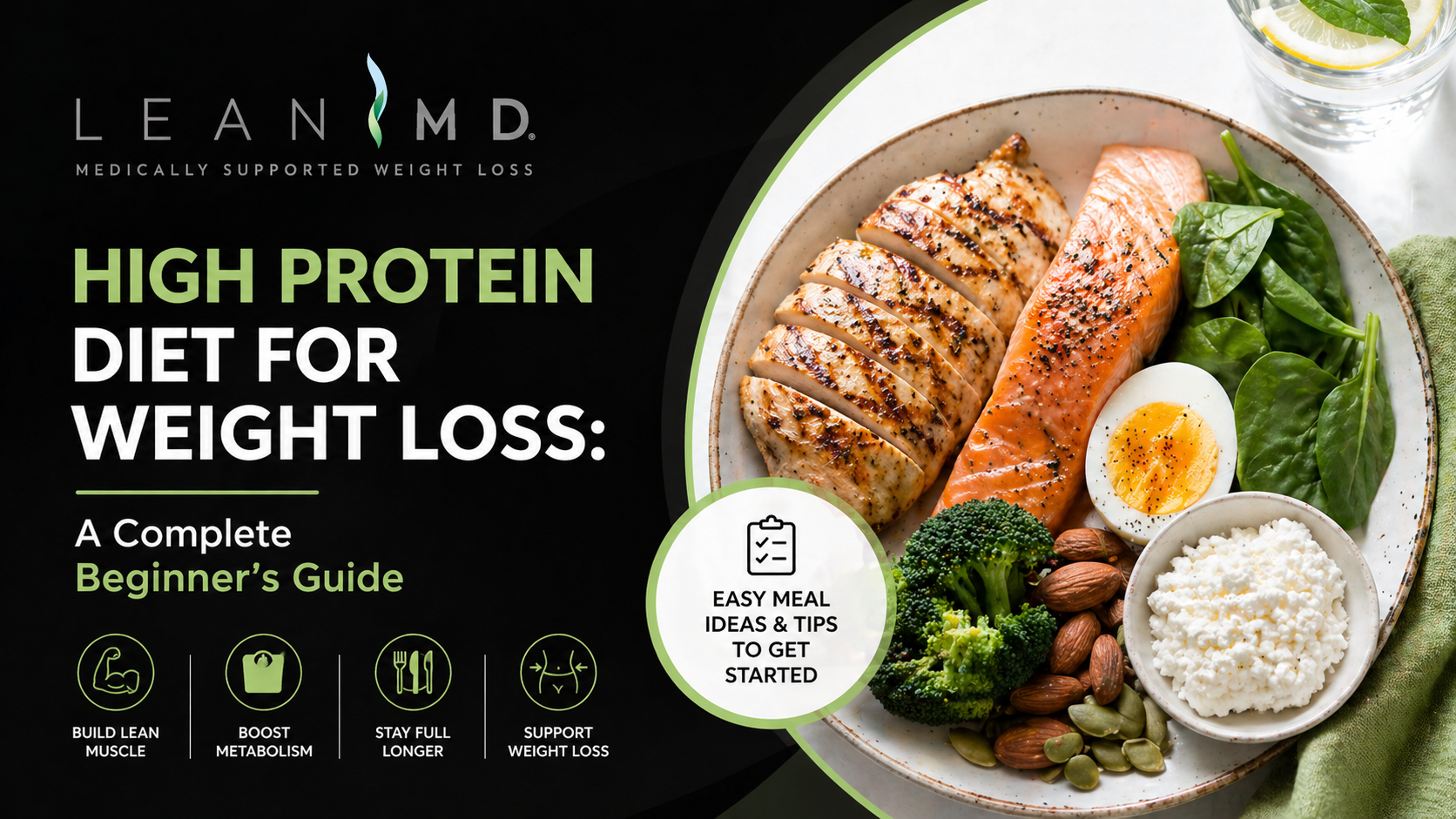
If you want to lose fat, preserve muscle, and stay full throughout the day — a high protein diet for weight loss is the most evidence-backed nutritional strategy available. It is not a fad. It is what every serious medical weight loss program, including LeanMD, is built around.
This beginner’s guide covers everything you need to know: why protein promotes fat loss, exactly how much you need daily, the best protein-rich foods to eat, common mistakes to avoid, a practical 3-day meal plan, and how a physician-supervised program takes your results to the next level.
Why Protein Is the #1 Macronutrient for Weight Loss
Not all calories are equal — and protein proves it. Among the three macronutrients (protein, carbohydrates, and fat), protein has a uniquely powerful effect on weight loss through four distinct mechanisms:
30%of protein calories burned during digestion (thermic effect) vs. just 5–10% for carbs and fat
441extra calories burned per day on average in high-protein dieters (Weigle et al., 2005)
60%reduction in late-night snacking in patients on a high-protein diet
3×more effective at preserving lean muscle during weight loss than low-protein diets
Mechanism 1: The Thermic Effect of Protein
Your body burns calories simply to digest and process food — this is called the thermic effect of food (TEF). Protein has a thermic effect of 20–30%, meaning your body burns roughly 25 calories for every 100 calories of protein you eat. Fat and carbohydrates have a thermic effect of only 5–10%. This means a high-protein diet literally turns up your metabolism just through the act of eating.
Mechanism 2: Superior Satiety and Appetite Control
Protein is the most satiating macronutrient by a wide margin. It reduces levels of the hunger hormone ghrelin and increases levels of satiety hormones including PYY, GLP-1, and CCK. In practice, this means you naturally eat less without fighting hunger — a critical advantage for anyone trying to maintain a calorie deficit long-term.
Mechanism 3: Muscle Preservation During Fat Loss
This is perhaps protein’s most underappreciated benefit. When you are in a calorie deficit, your body is at risk of burning muscle tissue for energy — a process called muscle catabolism. Adequate protein intake is the primary defense against this. Preserving muscle mass matters enormously because:
- Muscle is metabolically active tissue — more muscle means a higher resting metabolism
- Patients who lose muscle alongside fat regain weight much faster after stopping a diet
- Muscle loss leads to the “skinny fat” outcome — lower scale weight but poor body composition
Mechanism 4: Reduced Cravings and Blood Sugar Stability
Protein-rich meals slow the absorption of glucose into the bloodstream, preventing the sharp blood sugar spikes and crashes that trigger intense cravings for sugary, high-calorie foods. Stabilizing blood sugar is one of the most practical ways to reduce unplanned snacking and emotional eating.
✅ Why LeanMD Puts Protein First
LeanMD’s physician-supervised weight loss program is built on a muscle-first, protein-forward nutritional philosophy. Every patient receives a personalized daily protein target — calculated from their actual lean body mass, not a generic guideline. This is how LeanMD patients lose fat consistently while protecting the muscle that keeps their metabolism strong and their results lasting.
How Much Protein Do You Actually Need Per Day?
The standard government RDA for protein is 0.8 grams per kilogram of body weight. For weight loss — especially when you want to preserve muscle — this is far too low. Current research and clinical practice consistently support higher targets.
| Goal | Recommended Daily Protein | Example: 180 lb (82 kg) Person |
|---|---|---|
| Sedentary adult (basic health) | 0.8 g per kg body weight | ~66 g/day — bare minimum, not ideal for weight loss |
| General weight loss | 1.2–1.6 g per kg body weight | ~100–130 g/day |
| Active weight loss + muscle preservation | 1.6–2.0 g per kg body weight | ~130–165 g/day |
| GLP-1 medication users (semaglutide, tirzepatide) | 1.8–2.2 g per kg lean body mass | ~130–170 g/day — critical to prevent muscle loss |
| Active resistance training + fat loss | 2.0–2.4 g per kg body weight | ~165–195 g/day |
⚠ Important: Protein Targets Should Be Based on Lean Body Mass
For people with significant weight to lose, basing protein targets on total body weight can set unnecessarily high targets. The most accurate approach — used in LeanMD’s program — is to base targets on lean body mass (your weight minus fat mass). This ensures you are eating enough protein to protect muscle without overshooting on calories. Your LeanMD physician calculates this individually for you.
How to Calculate Your Daily Protein Target
📊 Protein Calculator — Quick Reference
Step 1 — Find your weight in kgYour weight (lbs) ÷ 2.2 = kg
Step 2 — Choose your multiplierWeight loss: 1.6 g/kg · Active: 2.0 g/kg
Step 3 — Multiplykg × multiplier = daily protein grams
Example: 180 lb person, weight loss goal82 kg × 1.6 = ~131 g protein/day
Example: 220 lb person, active + GLP-1100 kg × 2.0 = ~200 g protein/day
Pro tip: Spread your protein across 3–5 meals or snacks throughout the day. Research shows that protein synthesis is maximized when you consume 25–40 grams per sitting — not all at once. A single large protein meal late in the day is not as effective as consistent protein distribution.
Best Protein Foods for Weight Loss
The best protein foods for weight loss are those that deliver high protein per calorie — maximizing satiety without blowing your calorie budget. Here are the top categories:
Lean Animal Proteins — Highest Protein Density
🍗
Chicken Breast
31g / 165 calPer 100g cooked. The ultimate lean protein — versatile, affordable, and easy to meal prep.
🦃
Turkey Breast
29g / 135 calPer 100g cooked. Slightly leaner than chicken; great in wraps, stir-fries, and salads.
🥚
Eggs
13g / 155 calPer 2 large eggs. Contains all essential amino acids; egg whites add pure protein at ~60 cal per cup.
🐟
Tuna (canned)
25g / 109 calPer 100g. One of the highest protein-to-calorie ratios available; rich in omega-3s.
🍣
Salmon
25g / 208 calPer 100g. Higher fat but anti-inflammatory omega-3s support metabolism and reduce inflammation linked to obesity.
🥩
Lean Beef
26g / 215 calPer 100g (90% lean). Rich in creatine and iron; choose sirloin, round, or extra-lean ground beef.
🦐
Shrimp
24g / 99 calPer 100g cooked. One of the leanest proteins available — nearly zero fat and very low calorie.
🧀
Greek Yogurt
17g / 100 calPer 170g (plain, non-fat). Double-strained for higher protein; great breakfast or snack base.
Read More :- Medical Weight Loss Programs: What They Are & How They Work
Plant-Based Protein Sources
| Food (per 100g cooked) | Protein | Calories | Best Used As |
|---|---|---|---|
| Edamame | 11g | 121 cal | Snack, salad topping, side dish |
| Lentils | 9g | 116 cal | Soups, stews, grain bowls |
| Black beans | 9g | 132 cal | Wraps, salads, side dishes |
| Chickpeas | 9g | 164 cal | Roasted snacks, curries, salads |
| Firm tofu | 17g | 144 cal | Stir-fries, scrambles, grilled dishes |
| Tempeh | 19g | 193 cal | Best complete plant protein; great in bowls and sandwiches |
| Cottage cheese (low-fat) | 12g | 98 cal | Breakfast bowl, dip, pre-bed protein snack |
| Quinoa | 4g | 120 cal | Complete amino acid grain; base for grain bowls |
💡 Protein Quality Matters — Complete vs. Incomplete Proteins
Animal proteins (meat, fish, eggs, dairy) are complete proteins — they contain all nine essential amino acids your body cannot make itself. Most plant proteins are incomplete and must be combined to cover all amino acids (e.g., rice + beans). If you follow a plant-based diet, tempeh, edamame, quinoa, and soy protein are your best complete options. Protein powder from whey, casein, or soy can also help fill gaps.
3-Day High Protein Meal Plan for Beginners
Here is a practical 3-day high protein meal plan for weight loss based on approximately 130–150g of protein and 1,500–1,700 calories daily — a suitable starting range for many adults pursuing fat loss. Adjust portions based on your personal targets (calculated above).
Day 1~1,600 cal · ~140g protein
Breakfast3-egg omelette with spinach and feta + 1 cup plain Greek yogurt with berries~42g
Snack1 oz almonds + 1 part-skim string cheese~10g
Lunch5 oz grilled chicken breast over mixed greens with cucumber, cherry tomatoes, and lemon-olive oil dressing~43g
Snack½ cup low-fat cottage cheese with sliced bell peppers~14g
Dinner5 oz baked salmon + 1 cup steamed broccoli + ½ cup quinoa~38g
Day 2~1,580 cal · ~138g protein
BreakfastProtein smoothie: 1 scoop whey protein + 1 cup unsweetened almond milk + ½ banana + 1 tbsp peanut butter + ice~35g
Snack2 hard-boiled eggs + raw veggie sticks~13g
LunchTurkey and avocado lettuce wrap (5 oz lean turkey, ¼ avocado, tomato, mustard, romaine leaves)~40g
Snack½ cup plain Greek yogurt + 1 tbsp chia seeds~12g
Dinner5 oz lean ground beef stir-fry with zucchini, bell peppers, and soy sauce over cauliflower rice~38g
Day 3~1,540 cal · ~135g protein
Breakfast½ cup oats cooked with 1 scoop vanilla protein powder, topped with sliced almonds and cinnamon~33g
Snack1 cup edamame (shelled) with a pinch of sea salt~17g
Lunch5 oz canned tuna in water mixed with Greek yogurt, celery, and Dijon over romaine lettuce cups~40g
Snack1 oz beef jerky (low sodium) + 1 small apple~9g
Dinner5 oz grilled shrimp + roasted asparagus + ½ cup lentils + squeeze of lemon~40g
📌 Meal Plan Notes for Beginners
- These are starting templates — portions should be adjusted to your personal protein and calorie targets
- Drink at least 8–10 glasses of water daily; protein metabolism requires good hydration
- Prep proteins in bulk on Sundays (chicken, hard-boiled eggs, ground turkey) to make daily adherence easy
- If on a GLP-1 medication like semaglutide or tirzepatide, smaller and more frequent protein servings may suit your reduced appetite better than 3 large meals
- A LeanMD physician creates a fully personalized meal plan based on your exact lean body mass, labs, and health history
10 Practical Tips to Hit Your Protein Goals Every Day
Knowing your protein target is step one. Here is how to actually reach it consistently — without obsessing over every gram:
01 . Start every meal with protein
Eat your protein first at every meal. It triggers satiety hormones faster and helps prevent overeating carbs and fats later in the meal.
02. Batch-cook proteins weekly
Grill a batch of chicken breasts, hard-boil a dozen eggs, and cook a pound of ground turkey every Sunday. Pre-cooked protein is the single biggest predictor of daily adherence.
03. Replace carb-heavy snacks with protein snacks
Swap chips and crackers for Greek yogurt, cottage cheese, hard-boiled eggs, beef jerky, or edamame. Same snack habit, completely different metabolic outcome.
04. Use protein powder strategically
Whey, casein, or plant protein powders are not just for gym-goers. Adding a scoop to oatmeal, smoothies, or yogurt is one of the easiest ways to add 20–25g of protein to a meal.
05. Track protein for the first 2–4 weeks
Most people significantly underestimate their protein intake. Use a free app like Cronometer or MyFitnessPal to track for a few weeks — you’ll quickly learn which meals consistently fall short.
06. Upgrade your breakfast first
Breakfast is where most people fall furthest behind on protein. Swap cereal or toast for eggs, Greek yogurt, or a protein smoothie and you will start every day 30–40g ahead.
07. Order protein first when eating out
When dining out, choose an entrée anchored around a lean protein (grilled fish, chicken, or steak) and ask for extra vegetables instead of starchy sides. Most restaurants accommodate easily.
08. Add protein to vegetable-heavy meals
Salads, stir-fries, and soups are nutritious but often protein-light. Always add a protein source: shrimp, chicken, tofu, edamame, or a boiled egg. Never eat a protein-free meal.
09. Keep a protein-rich emergency snack on hand
Hunger strikes unexpectedly. Keep portable protein options available: single-serve Greek yogurt cups, protein bars (10g+ protein, minimal sugar), beef jerky, or protein powder packets.
10. Do not fear protein at dinner
A common myth says protein at night causes weight gain. Research does not support this. Eating protein at dinner — especially casein-rich foods like cottage cheese or Greek yogurt — actually supports overnight muscle repair.
5 High Protein Diet Myths — Busted
Misinformation about high protein diets is widespread. Here is the evidence-based truth behind the most common concerns:
MYTH
High protein diets damage your kidneys.
FACT
In healthy people, there is no evidence that high protein intake harms kidney function.
This concern originated from studies in patients who already had chronic kidney disease, where protein restriction is sometimes warranted. For healthy adults with no pre-existing kidney conditions, consuming 1.6–2.4g of protein per kg body weight is safe, well-tolerated, and clinically supported.
MYTH
Eating more protein automatically makes you gain muscle.
FACT
Protein alone does not build muscle — resistance training does.
Adequate protein provides the building blocks (amino acids) for muscle synthesis, but strength training is the stimulus that triggers it. Without progressive resistance exercise, extra protein is simply oxidized for energy. During weight loss, adequate protein primarily functions to preserve existing muscle, not build new muscle.
MYTH
Your body can only absorb 30 grams of protein per meal.
FACT
Your body can digest and absorb virtually unlimited protein — the “30g limit” is a fitness myth.
What research does support is that muscle protein synthesis is maximally stimulated by approximately 20–40g of protein per meal. Eating more than this in a single sitting does not harm you — extra protein is simply used for energy or other metabolic functions. However, distributing protein evenly across meals does optimize muscle preservation.
MYTH
High protein diets are just a trend — they are not sustainable long-term.
FACT
High protein eating is not a temporary diet — it is a nutritional foundation supported by decades of research.
The most successful long-term weight maintainers consistently report high protein intake as a key strategy. Unlike restrictive diets that eliminate entire food groups, a protein-forward approach simply shifts the macronutrient emphasis without banning any specific foods, making it one of the most sustainable dietary approaches available.
MYTH
Plant-based eaters cannot get enough protein for weight loss.
FACT
A well-planned plant-based diet can absolutely meet high protein targets.
It requires more intentionality — prioritizing tempeh, tofu, legumes, edamame, and plant-based protein powders, and combining incomplete proteins strategically. It is harder but entirely achievable, especially with physician guidance. LeanMD’s program supports plant-based patients with customized protein plans.
High Protein Diets and GLP-1 Weight Loss Medications
If you are using or considering a GLP-1 medication like semaglutide (Wegovy) or tirzepatide (Zepbound), protein intake becomes even more critical — not less.
GLP-1 medications dramatically reduce appetite and food intake. This is precisely how they work. But the risk is that in a deep calorie deficit, your body turns to muscle tissue for energy. Studies on semaglutide and tirzepatide show that 25–40% of total weight lost can be lean muscle mass without a structured protein strategy.
| Scenario | Weight Lost | Fat Lost | Muscle Lost | Metabolic Outcome |
|---|---|---|---|---|
| GLP-1 medication — no protein plan | 40 lbs | ~25–28 lbs | ~12–15 lbs | Slower metabolism; high regain risk |
| GLP-1 medication + high protein diet | 40 lbs | ~36–38 lbs | ~2–4 lbs | Preserved metabolism; lower regain risk |
| GLP-1 + protein + resistance training | 40 lbs | ~38–40 lbs | Near zero or slight gain | Strongest metabolic outcome; best long-term results |
✅ LeanMD’s Approach: Protein + GLP-1 + Physician Monitoring
Every LeanMD patient on a GLP-1 medication receives a personalized protein target, a practical nutrition plan, and regular body composition monitoring to ensure fat — not muscle — is being lost. This is the clinical difference between a program and a prescription.
Frequently Asked Questions About High Protein Diets for Weight Loss
How much protein per day should I eat to lose weight?
For active weight loss with muscle preservation, most research supports 1.6–2.0 grams of protein per kilogram of body weight per day. For a 180-pound (82 kg) person, that is roughly 130–165 grams of protein daily. If you are using a GLP-1 medication, targeting the higher end of this range is especially important to prevent muscle loss.
Can you lose weight on a high protein diet without counting calories?
Yes — and this is one of protein’s biggest advantages. Because protein is so satiating, most people naturally eat fewer calories when they prioritize protein-rich foods. Many studies show spontaneous calorie reduction of 300–500 calories per day when protein intake increases to 25–30% of total calories, without deliberate calorie restriction.
What is the best protein for weight loss — animal or plant?
Both can be highly effective. Animal proteins (chicken, fish, eggs, Greek yogurt) are generally more protein-dense and contain all essential amino acids, making them easier to hit targets with. Plant proteins (tempeh, tofu, legumes) require more planning but offer additional fiber and micronutrient benefits. The “best” protein is the one you will actually eat consistently.
Is a high protein diet safe for older adults?
Yes — and it may be even more important for older adults. Muscle loss (sarcopenia) accelerates after age 50, and higher protein intake (up to 2.0 g/kg) combined with resistance exercise is one of the most effective strategies for preserving muscle mass, functional strength, and metabolic health with age. As always, consult your physician before making significant dietary changes.
Will a high protein diet put me in ketosis?
Not necessarily. Ketosis requires very low carbohydrate intake (typically below 50g/day), not just high protein. A high protein diet can coexist with moderate carbohydrate intake. LeanMD’s approach is protein-forward but not inherently ketogenic — carbohydrates are included strategically based on individual goals and health markers.
How do I get enough protein if I have a small appetite on semaglutide?
This is one of the most common challenges for GLP-1 medication users. The most effective strategies: prioritize protein at every meal before eating carbs or fats, choose calorie-efficient protein sources (Greek yogurt, cottage cheese, protein shakes), eat smaller meals more frequently (every 3–4 hours), and consider a high-quality protein supplement. Your LeanMD physician can adjust your plan specifically for reduced-appetite eating.
Do I need to take protein supplements on a high protein diet?
Not necessarily, but protein powders and supplements can make it significantly easier to hit higher targets — especially on days when appetite is low or meal prep falls short. Whey protein is the most studied and effective option for muscle preservation. Plant-based blends (pea + rice protein) are a strong alternative for those avoiding dairy. Focus on whole food proteins first, and use supplements to fill the gap.
The Bottom Line: Protein Is the Foundation of Lasting Weight Loss
A high protein diet for weight loss is not just another trend. It is the most well-supported nutritional strategy for losing fat, preserving muscle, controlling hunger, and maintaining your results long-term. Whether you are just beginning your weight loss journey or already using a GLP-1 medication, getting your protein right is the single most impactful change you can make to your diet today.
The challenge for most people is not knowing what to do — it is getting the personalized targets, practical guidance, and ongoing accountability to actually do it consistently. That is exactly what LeanMD’s physician-supervised program delivers.
Get Your Personalized Protein Plan from a LeanMD Physician
LeanMD creates individualized protein targets, nutrition plans, and muscle-protecting protocols — paired with physician supervision and GLP-1 medications when appropriate.Find a LeanMD Physician Near You
Physician-supervised · Muscle-first · Real food · Long-term results
Read More :- GLP-1 Weight Loss Medications Compared: Ozempic vs Wegovy vs Mounjaro