
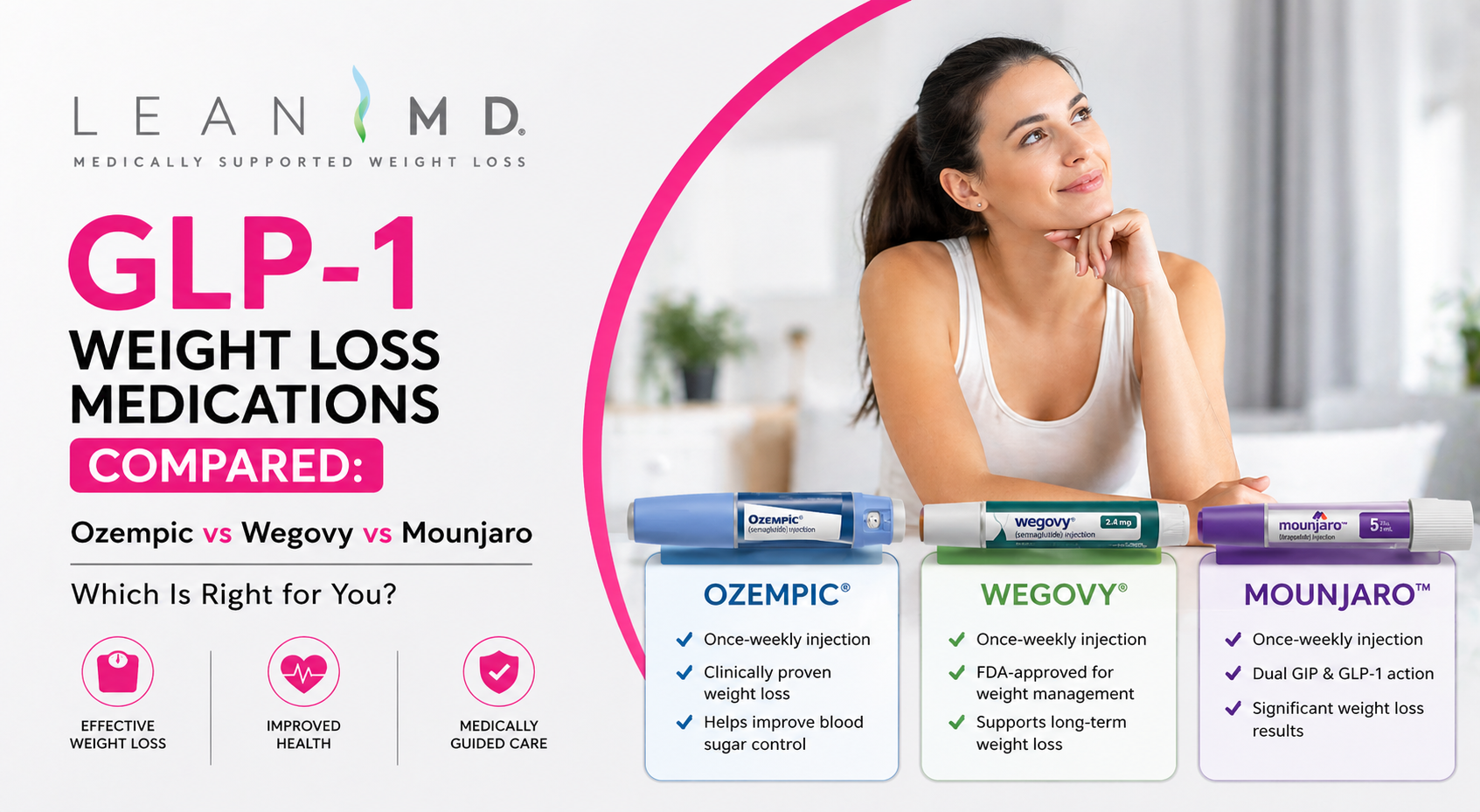
GLP-1 weight loss medications have changed the landscape of obesity treatment forever. But with Ozempic, Wegovy, Mounjaro, and Zepbound all making headlines, patients are understandably confused — which one actually works best, and which one is right for your body?
This physician-reviewed guide breaks down every major GLP-1 weight loss medication currently available — comparing mechanisms, clinical results, side effects, dosing schedules, costs, and who each is best suited for. By the end, you will have a clear, evidence-based picture to discuss with your LeanMD physician.
What Are GLP-1 Weight Loss Medications?
GLP-1 stands for glucagon-like peptide-1 — a hormone naturally produced in your gut after eating. It signals your brain that you are full, slows digestion, and regulates blood sugar. GLP-1 receptor agonists are medications that mimic this hormone, amplifying its effects to produce meaningful, sustained weight loss.
What makes GLP-1 medications revolutionary is their ability to address the biological drivers of obesity — not just willpower or caloric math. For the first time, patients can achieve results previously only possible through bariatric surgery, without going under the knife.
The Main GLP-1 Weight Loss Medications: A Quick Overview
Here are the four medications you will hear most about — two based on semaglutide, two on tirzepatide:
Ozempic®
Semaglutide 0.5–2 mg
Wegovy®
Semaglutide 2.4 mg
Mounjaro®
Tirzepatide 2.5–15 mg
Zepbound®
Tirzepatide 2.5–15 mg
Semaglutide vs Tirzepatide — How Are They Different?
Both are GLP-1 medications, but they work differently at the molecular level — and that difference has a real impact on weight loss results.
| Feature | Semaglutide (Ozempic / Wegovy) | Tirzepatide (Mounjaro / Zepbound) |
|---|---|---|
| Hormone targeted | GLP-1 only | GLP-1 + GIP (dual agonist) |
| How it reduces appetite | Signals fullness to the brain via GLP-1 pathway | Signals fullness via both GLP-1 and GIP pathways — more powerful combined effect |
| Effect on metabolism | Moderate metabolic improvement | Greater improvement in fat metabolism due to GIP receptor activation |
| Average weight loss | ~15% body weight (Wegovy trial) | ~20–22% body weight (SURMOUNT-1 trial) |
| Blood sugar control | Excellent — improves insulin secretion | Superior — dual-hormone action gives stronger glucose control |
| Long-term safety data | More extensive (approved since 2017 for diabetes) | Strong but newer — approved for diabetes 2022, obesity 2023 |
| FDA-approved for obesity? | Yes — Wegovy (2021) | Yes — Zepbound (2023) |
🔬 Why Does the Dual GIP + GLP-1 Action Matter?
GIP (glucose-dependent insulinotropic polypeptide) works alongside GLP-1 to further reduce appetite, improve fat burning, and enhance insulin sensitivity. Tirzepatide activating both receptors simultaneously is why clinical trials show it outperforming semaglutide on average weight lost — though both are clinically remarkable medications.
Ozempic vs Wegovy vs Mounjaro vs Zepbound — The Full Comparison
Now the head-to-head you came for. Here is every key factor compared across all four major GLP-1 weight loss medications:
| Category | Ozempic® | Wegovy® | Mounjaro® | Zepbound® |
|---|---|---|---|---|
| Active ingredient | Semaglutide | Semaglutide | Tirzepatide | Tirzepatide |
| Mechanism | GLP-1 agonist | GLP-1 agonist | GLP-1 + GIP dual | GLP-1 + GIP dual |
| FDA-approved use | Type 2 diabetes | Obesity / weight mgmt | Type 2 diabetes | Obesity / weight mgmt |
| Starting dose | 0.25 mg/week | 0.25 mg/week | 2.5 mg/week | 2.5 mg/week |
| Maximum dose | 2 mg/week | 2.4 mg/week | 15 mg/week | 15 mg/week |
| Dose escalation | ~16–20 weeks | ~16–20 weeks | ~20 weeks | ~20 weeks |
| Avg. weight loss | ~10–12% | ~15% | ~15–20% | ~20–22% |
| Avg. lbs lost (trials) | ~22–26 lbs | ~34 lbs | ~35–42 lbs | ~48 lbs |
| Administration | Weekly injection | Weekly injection | Weekly injection | Weekly injection |
| List price (est.) | ~$900–1,000/mo | ~$1,300–1,400/mo | ~$1,000–1,100/mo | ~$1,000–1,100/mo |
| Insurance coverage (obesity) | Variable (off-label) | Yes (on-label) | Variable (off-label) | Yes (on-label) |
| Cardiovascular benefit data | Yes (SELECT trial) | Yes (SELECT trial) | Ongoing (SURPASS-CVOT) | Ongoing (SURPASS-CVOT) |
| Safety track record | Longest (since 2017) | Strong (since 2021) | Good (since 2022) | Newest (since 2023) |
| Best suited for | T2D patients; off-label weight loss | Obesity; most studied for weight | T2D + weight loss; off-label | Obesity; highest efficacy option |
★ Highlighted row shows the category where Zepbound currently leads. Prices are estimates and vary by pharmacy and insurance. Consult your LeanMD physician for current pricing and coverage guidance.
Ozempic vs Wegovy: What Is the Actual Difference?
This is one of the most searched questions about GLP-1 weight loss medications — and the answer surprises many people.
Ozempic and Wegovy contain the exact same active ingredient: semaglutide. The key differences are dose and FDA-approved indication:
💡 Key Takeaway on Ozempic vs Wegovy
If your goal is weight loss and you do not have type 2 diabetes, Wegovy is the on-label, insurance-supported choice when semaglutide is indicated. Ozempic for weight loss is common but technically off-label — your LeanMD physician will advise which is appropriate based on your health profile and insurance coverage.
Side Effects Comparison: Ozempic, Wegovy, and Mounjaro
All three medications share similar side effect profiles because they all activate GLP-1 receptors. Tirzepatide adds GIP activation, which slightly alters the profile.
| Side Effect | Ozempic® | Wegovy® | Mounjaro® / Zepbound® |
|---|---|---|---|
| Nausea | Very common (36%) | Very common (44%) | Very common (28–33%) |
| Vomiting | Common (15%) | Common (24%) | Common (20–24%) |
| Diarrhea | Common (19%) | Common (30%) | Common (17–23%) |
| Constipation | Moderate (11%) | Common (24%) | Common (18–21%) |
| Injection site reactions | Common (3–5%) | Common (3–5%) | Common (3–7%) |
| Fatigue | Moderate | Moderate | Moderate |
| Pancreatitis (rare) | Monitor carefully | Monitor carefully | Monitor carefully |
| Thyroid concerns | Contraindicated: MTC / MEN2 history | Contraindicated: MTC / MEN2 history | Contraindicated: MTC / MEN2 history |
| Side effects typically peak | Weeks 2–8 | Weeks 2–8 | Weeks 2–8 |
| Side effects resolve? | Yes — usually within 4–8 weeks | Yes — usually within 4–8 weeks | Yes — usually within 4–8 weeks |
✅ How LeanMD Minimizes Side Effects
The most effective way to minimize GLP-1 side effects is careful dose escalation managed by a physician. At LeanMD, every patient’s escalation schedule is personally overseen — starting at the lowest dose and increasing gradually based on individual tolerance, not a generic calendar. This is a key reason LeanMD patients report better tolerability than those self-managing from online sources.
Which GLP-1 Medication Is Right for You?
There is no single “best” GLP-1 weight loss medication — the right choice depends on your health profile, goals, medical history, and insurance coverage. Here is a practical framework:
| If You Are… | Consider… | Why |
|---|---|---|
| New to GLP-1 medications with no diabetes | Wegovy® (semaglutide 2.4 mg) | On-label for obesity, most insurance coverage, strongest long-term safety data for weight loss |
| Managing type 2 diabetes + wanting weight loss | Ozempic® or Mounjaro® | Both FDA-approved for T2D with meaningful weight loss benefits; Mounjaro shows superior glucose control |
| Wanting maximum possible weight loss | Zepbound® (tirzepatide 15 mg) | Highest average weight loss in trials (~20–22%); dual GIP + GLP-1 mechanism |
| Concerned about side effects / first-time injections | Wegovy® or Ozempic® (semaglutide) | Longest safety track record; most physician experience managing side effects |
| Struggling with cardiovascular disease risk | Wegovy® (semaglutide) | SELECT trial showed 20% reduction in major cardiovascular events in non-diabetic patients with obesity |
| Cost-sensitive / limited insurance | Discuss with your physician | Manufacturer savings cards exist for all four. Your LeanMD physician can advise on the most affordable qualifying option |
⚕ Important: This Decision Requires a Physician
No online comparison guide — including this one — can replace an individualized medical consultation. Your physician will review your full health history, current medications, BMI, metabolic markers, and insurance coverage before recommending any GLP-1 medication. This is exactly what your first LeanMD consultation delivers.
The Risk All Four Medications Share — And How LeanMD Addresses It
Regardless of which GLP-1 weight loss medication you take, all four carry the same critical risk: loss of lean muscle mass alongside fat.
When appetite is dramatically reduced, the body can enter a calorie deficit so deep that it begins breaking down muscle tissue for energy. Studies on semaglutide and tirzepatide both show that up to 30–40% of total weight lost can be lean muscle when the medication is used without a structured protein and resistance training plan.
Losing muscle slows your metabolism permanently, makes you more likely to regain weight after stopping medication, and robs you of the strength and energy gains that make weight loss genuinely life-changing.
✅ LeanMD’s Muscle-First Approach — Built for Every GLP-1 Medication
- Personalized protein targets based on your current lean body mass — recalculated at every check-in
- Strength-focused movement plans introduced progressively as you lose weight
- Body composition monitoring — tracking fat mass vs. muscle mass, not just scale weight
- Nutritional supplement protocol to support metabolism, energy, and muscle preservation
- 1:1 physician coaching throughout — adjusting your plan as your body changes
What to Expect When Starting a GLP-1 Weight Loss Medication
Whether your physician prescribes semaglutide or tirzepatide, the process of starting a GLP-1 weight loss medication follows a similar path at LeanMD:
Frequently Asked Questions About GLP-1 Weight Loss Medications
Is Mounjaro the same as Wegovy?
No. Mounjaro (tirzepatide) and Wegovy (semaglutide) are different drugs with different active ingredients. Wegovy activates only GLP-1 receptors; Mounjaro activates both GLP-1 and GIP receptors, producing stronger average weight loss in clinical trials. Mounjaro is FDA-approved for type 2 diabetes; Zepbound (the same drug) is FDA-approved for obesity.
Which GLP-1 medication causes the most weight loss?
Based on current clinical trial data, tirzepatide (Zepbound/Mounjaro) at the 15 mg dose produces the highest average weight loss — approximately 20–22% of body weight, or around 48 lbs on average in the SURMOUNT-1 trial. However, individual results vary significantly, and the “best” medication for you depends on your health profile, not just trial averages.
Can I switch from Ozempic to Wegovy or Mounjaro?
Yes, switching is possible and common, but it must be done under physician supervision. Dosing schedules, washout periods, and individual health factors all affect how a switch should be managed. Your LeanMD physician can advise whether switching is appropriate and how to transition safely.
How long do I need to take a GLP-1 medication for weight loss?
Most clinical guidelines and obesity specialists recommend GLP-1 medications as long-term or indefinite treatments for obesity — similar to how blood pressure or cholesterol medications are used chronically. At LeanMD, Phase 1 typically runs 2–12 months, after which medication is tapered during the transition phase as sustainable habits take over.
Are GLP-1 medications covered by insurance?
Coverage varies significantly. Wegovy and Zepbound (the on-label obesity versions) are most likely to be covered for qualifying patients. Ozempic and Mounjaro used off-label for weight loss may not be covered. Many manufacturers offer savings programs. The LeanMD team helps patients navigate insurance and prior authorization.
Is it safe to buy GLP-1 medications online without a prescription?
No. GLP-1 medications are prescription-only in the United States. Compounded semaglutide from online pharmacies without a proper medical consultation carries serious safety risks — including unknown purity, incorrect dosing, and no monitoring for side effects or contraindications. Always work with a licensed physician.
Do GLP-1 medications cause muscle loss?
They can — if not paired with adequate protein intake and resistance exercise. Studies show 25–40% of weight lost on GLP-1 medications can be lean muscle without a protective plan. LeanMD’s program is specifically designed to prevent this through personalized protein targets, strength guidance, and body composition monitoring.
The Bottom Line: Which GLP-1 Weight Loss Medication Is Best?
All four major GLP-1 weight loss medications — Ozempic, Wegovy, Mounjaro, and Zepbound — are genuinely effective. The “best” one is not universal — it is the one that is clinically appropriate for your body, prescribed at the right dose, and supported by a complete physician-supervised program.
If you are not losing fat, protecting your muscle, and building habits that outlast the medication, you are only getting half the picture. That is the problem LeanMD was built to solve.
Not Sure Which GLP-1 Medication Is Right for You?
A LeanMD physician will review your health profile and recommend the most appropriate medication — paired with a complete muscle-protecting, results-lasting weight loss program.
Book a Consultation at LeanMDRead More :- Medical Weight Loss Programs: What They Are & How They Work