
You have probably tried at least one diet. Maybe several. Keto, intermittent fasting, calorie counting, a cleanse, a meal delivery program. And like most people, you probably saw results at first.
The frustrating pattern that most people experience: weight comes off, weight comes back. Sometimes more comes back than you lost. You blame yourself, try something stricter next time, and the cycle continues. Sound familiar?
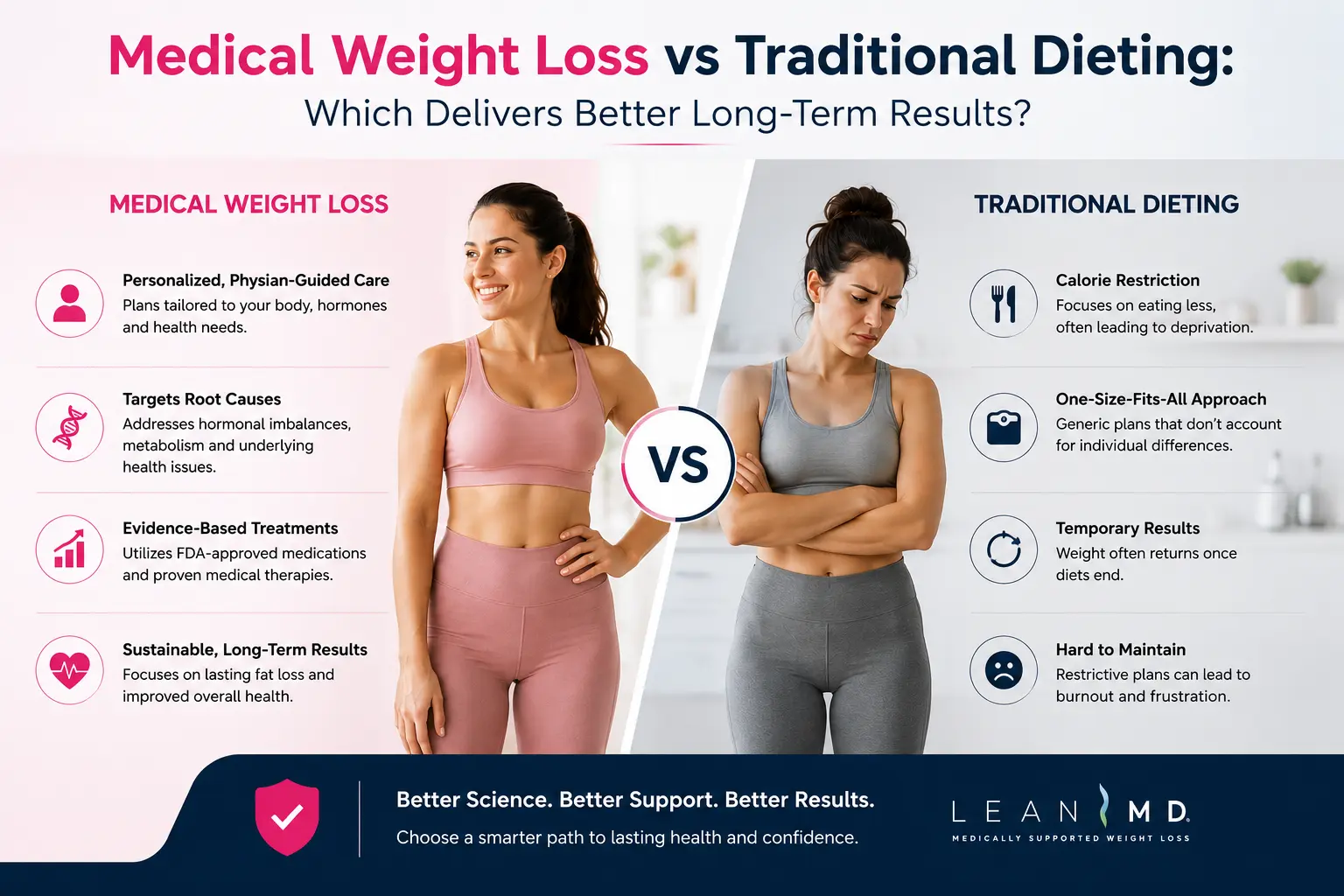
Here is what that cycle actually tells you: the method was working on the wrong problem. Traditional diets address the symptom — excess weight — without addressing the biological, hormonal, and metabolic causes underneath it. Medical weight loss takes a fundamentally different approach.
This guide compares the two approaches honestly and head-to-head — on effectiveness, sustainability, safety, and long-term outcomes — so you can make an informed decision about which path is right for you.
| THE VERDICT For short-term weight loss, both approaches can work. For long-term, sustainable results, medical weight loss consistently outperforms traditional dieting. Research shows that 80% of people who lose weight through dieting alone regain it within 5 years — because diets treat a symptom, not the cause. Medical weight loss addresses the metabolic, hormonal, and behavioral drivers that diets ignore. |
| 80% Of traditional dieters regain lost weight within 5 years | 14.9% Average weight loss with physician-supervised semaglutide (STEP trial) | 3x More likely to maintain weight loss with ongoing physician support vs. dieting alone |
1. Defining the Two Approaches
What is traditional dieting?
Traditional dieting refers to any self-directed weight loss approach based primarily on reducing calorie intake and/or increasing activity — without physician oversight, metabolic testing, or prescription medication. This includes commercial programs (Weight Watchers, Noom, Jenny Craig), popular diet methods (keto, intermittent fasting, low-fat diets), and generic meal plans.
Traditional diets are accessible, low-cost upfront, and often produce initial results. The problem is not that they fail to create weight loss — it is that they almost universally fail to maintain it.
What is medical weight loss?
Medical weight loss is a physician-supervised approach that begins with a diagnostic evaluation — including lab work, metabolic assessment, and medical history review — to identify the specific biological factors contributing to each patient’s weight. Treatment is then individualized based on those findings and can include prescription medication, clinical nutrition guidance, behavioral coaching, and a structured maintenance phase.
The key distinction is physician oversight at every stage — not just at the start, but throughout treatment and into the maintenance period. Medical weight loss treats obesity as the chronic condition it is, not as a temporary problem that ends when a “program” finishes.
Ready to Try Weight Loss That Actually Lasts?
LeanMD’s physician-supervised program combines metabolic assessment, personalized nutrition, GLP-1 medication when appropriate, and a structured maintenance phase — everything traditional dieting leaves out.
2. Head-to-Head Comparison: Medical Weight Loss vs. Traditional Dieting
Here is a comprehensive comparison across the factors that most determine whether weight loss succeeds and lasts:
| Category | Traditional Dieting | Medical Weight Loss (LeanMD) |
| Physician involvement | None — self-directed | Licensed physician oversight at every phase |
| Root cause assessment | Calories in vs. out only | Labs: insulin, thyroid, hormones — root cause identified |
| Average weight loss | 5–10% of body weight | 10–22% of body weight (medication-assisted) |
| Weight kept off at 5 years | Only ~20% maintain results | Significantly higher with ongoing support |
| Muscle preservation | Rarely addressed | Protein-first protocol, resistance guidance built in |
| Hormonal health | Ignored | Assessed and factored into treatment plan |
| Medication access | None | GLP-1, GIP agonists, Lipotropic B12 when appropriate |
| Maintenance phase | Ends with the diet | Structured 12-month Phase 3 maintenance |
| Personalization | Generic — same plan for everyone | Individualized to labs, history, and goals |
| Cost | Low upfront, high long-term (yo-yo) | Higher upfront, lower long-term (sustained results) |
| Why the Table Looks Lopsided: This is not marketing bias — it reflects the fundamental difference between treating a symptom and treating a condition. Traditional dieting was designed for motivated people in otherwise normal metabolic health. Medical weight loss was designed for the reality of how obesity actually works biologically. |
Read More :- Best Metabolic Weight Loss Center in California
3. Why Traditional Diets Fail Long-Term: The Biology
The 80% regain statistic is not a reflection of willpower failure. It is a predictable consequence of how the body responds to calorie restriction — and it is one of the most well-documented phenomena in obesity research.
Metabolic adaptation
When you reduce calories significantly, your body adapts by lowering its resting metabolic rate — sometimes by 200 to 500 calories per day or more. This is sometimes called “metabolic adaptation” or “starvation mode,” and it means that after a period of dieting, you burn fewer calories at the same weight than you did before you started. The same diet that once caused weight loss now simply maintains it — or causes regain if you increase calories even slightly.
Hormonal rebound
Calorie restriction triggers significant changes in the hormones that regulate hunger and fullness. Ghrelin (the hunger hormone) rises. Leptin (the fullness hormone) falls. These changes persist for months to years after dieting ends — creating a powerful biological drive to eat more that most people experience as a loss of willpower, when it is actually a measurable hormonal shift.
A landmark study published in the New England Journal of Medicine tracked participants from the Biggest Loser competition for 6 years after the show. Despite their extreme efforts, most had regained significant weight — and their metabolic rates were significantly lower and their hunger hormones significantly higher than before the show. The biology fought back, and biology won.
Muscle loss
Most traditional diets — particularly those emphasizing significant calorie restriction without adequate protein — cause substantial muscle loss alongside fat loss. Since muscle is the primary driver of resting metabolic rate, losing it during weight loss creates a compounding problem: slower metabolism, less ability to maintain activity levels, and a body that is increasingly efficient at storing the calories it gets.
| The Diet Cycle in Plain Terms: Diet → lose weight (fat AND muscle) → metabolism slows → hunger hormones rise → willpower depleted against biology → weight regain → try harder next time. Medical weight loss breaks this cycle not by demanding more willpower, but by addressing the biological mechanisms driving it. |
4. Why Medical Weight Loss Produces Better Long-Term Outcomes
It starts with diagnosis, not prescription
Medical weight loss begins by asking: why is this specific person struggling to lose weight? Is it insulin resistance? A thyroid disorder? Hormonal changes from age or menopause? Medication side effects? Chronic stress elevating cortisol? A generic diet plan addresses none of these. A physician-supervised approach identifies them through lab work and treats them directly.
Medication that addresses the biological drivers
GLP-1 and GLP-1/GIP receptor agonists (semaglutide, tirzepatide) represent a genuine breakthrough in obesity medicine — not because they burn calories differently, but because they address the hormonal dysregulation at the root of weight gain. They reduce the elevated hunger hormone signaling that makes dieting feel like swimming against a current, allowing patients to achieve meaningful calorie reduction without the white-knuckled willpower that eventually fails everyone.
The STEP clinical trials showed average weight loss of 14.9% of body weight with semaglutide — more than double what most traditional diets achieve and, crucially, with significantly better maintenance data than any comparable diet study.
Muscle preservation is built into the program
Medical weight loss programs that follow best practices — including LeanMD — build muscle preservation into the treatment from day one. This means personalized protein targets, structured resistance exercise guidance, and monitoring of lean mass alongside scale weight. This is what determines whether the weight you lose stays lost.
A structured maintenance phase
The most common reason for regain after medical weight loss is the same as the reason for regain after traditional dieting: the program ends. The difference is that the best medical weight loss programs anticipate this and build in a formal maintenance phase — continuing physician oversight, metabolic monitoring, and behavioral support during the critical first year after active weight loss.
| LeanMD’s Phase 3: LeanMD’s 12-month maintenance phase is not a subscription upsell — it is a clinical recognition that the hardest part of weight loss is not losing the weight; it is not regaining it. Ongoing physician support during this window produces significantly better 5-year outcomes than leaving patients to manage independently after hitting their goal. |
5. Is Medical Weight Loss Right for Everyone?
Medical weight loss is the most evidence-supported path for long-term results — but it is not the right entry point for everyone in every situation. Here is an honest framework:
Medical weight loss is most appropriate when:
- BMI is 30 or higher (obesity), or 27 or higher with a related health condition
- Previous diet attempts have produced results that were not maintained long-term
- There is a suspected or confirmed metabolic barrier — insulin resistance, thyroid issue, hormonal shift
- Obesity-related health conditions are present — type 2 diabetes, high blood pressure, sleep apnea, high cholesterol
- The patient is willing to commit to physician oversight and the full treatment arc, including maintenance
Traditional dieting may be a reasonable starting point when:
- BMI is in the overweight range (25–29.9) without related health conditions and previous diet attempts have not been made
- Weight gain is recent and primarily behavioral (lifestyle changes from a new job, postpartum, injury recovery) rather than long-standing
- The goal is modest (5–10 lbs) and driven by preference rather than medical need
For most people reading this article — those who have tried dieting, seen results that did not last, and are looking for something that works differently — medical weight loss is not just an option. It is the appropriate next step.
6. Cost: Is Medical Weight Loss Worth It?
The most common objection to medical weight loss is cost. Physician visits, lab work, and prescription medication — particularly GLP-1 drugs — are more expensive upfront than buying a diet book or joining an app-based program.
But the comparison needs to account for the full picture:
- The average American spends over $1,200 per year on diet products, programs, and supplements — often cycling through multiple failed attempts
- The long-term healthcare cost of untreated obesity — through diabetes, cardiovascular disease, joint replacement, sleep apnea management, and medications — far exceeds the cost of effective treatment
- GLP-1 medications often have manufacturer savings programs that significantly reduce out-of-pocket costs for eligible patients
- Insurance coverage for obesity medicine is expanding — some plans now cover Wegovy and physician visits for weight management
The more accurate question is not “can I afford medical weight loss?” but “what is the cumulative cost — financial, physical, and emotional — of continuing to try approaches that are unlikely to produce lasting results?”
Ready to Try Weight Loss That Actually Lasts?
LeanMD’s physician-supervised program combines metabolic assessment, personalized nutrition, GLP-1 medication when appropriate, and a structured maintenance phase — everything traditional dieting leaves out.
Frequently Asked Questions
Does medical weight loss actually work better than dieting?
Yes — the research is consistent. Physician-supervised medical weight loss produces significantly greater average weight loss and far better long-term maintenance than self-directed dieting. The STEP trials showed ~15% average weight loss with semaglutide-based medical programs, compared to 5–10% typical of traditional diets. More importantly, the 5-year maintenance rates are dramatically different — traditional dieters regain weight at a rate of roughly 80% within 5 years, while patients in structured medical programs with maintenance phases perform significantly better.
What makes medical weight loss different from a diet plan?
Three things primarily. First, a physician evaluates the specific metabolic, hormonal, and medical factors contributing to your weight — rather than assuming a calorie deficit alone explains everything. Second, prescription medication can be used to address the hormonal drivers of hunger and fat storage that dieting alone cannot touch. Third, a formal maintenance phase continues support after active weight loss — which is when most traditional dieters regain their weight.
Can I do medical weight loss if I’ve already tried many diets?
Yes — and in fact, a history of multiple diet attempts with weight regain is one of the strongest indicators that a medical approach is appropriate. Repeated dieting cycles (yo-yo dieting) progressively worsen metabolic adaptation and hormonal dysregulation. A physician-supervised evaluation can identify what has been working against your efforts and address those factors directly.
Is physician-supervised weight loss covered by insurance?
Coverage varies by insurer and plan. Physician visits for obesity medicine are increasingly covered as insurers recognize obesity as a chronic condition. Wegovy (semaglutide for weight loss) is covered by some plans but not others. Ozempic for type 2 diabetes is more broadly covered. It is always worth checking your specific plan with the clinic before assuming coverage or exclusion.
How long does medical weight loss take compared to dieting?
Expect a longer, more deliberate timeline with medical weight loss — and frame this as a strength, not a weakness. Most structured medical programs run 12–24 months for active weight loss, followed by a maintenance phase. Traditional diets often promise faster results — which is exactly why they produce faster regain. Slower, physician-monitored weight loss preserves more muscle, produces more durable metabolic changes, and results in significantly better outcomes at the 2- and 5-year marks.
Do I have to take medication in a medical weight loss program?
No. Physician-supervised weight loss does not automatically mean medication. A physician evaluates each patient individually — medication is recommended only when the clinical picture supports it and the patient’s goals and preferences align with that approach. Some patients achieve excellent results through the nutritional, behavioral, and monitoring components of a medical program without any prescription medication.
Medical Disclaimer
This article is for informational purposes only and does not constitute medical advice. Always consult a qualified healthcare provider before starting any weight loss program or medication. Individual results vary. LeanMD’s program is physician-supervised and personalized to each individual patient.
Read More :- Best Place to Inject Semaglutide for Weight Loss: Complete Injection Guide